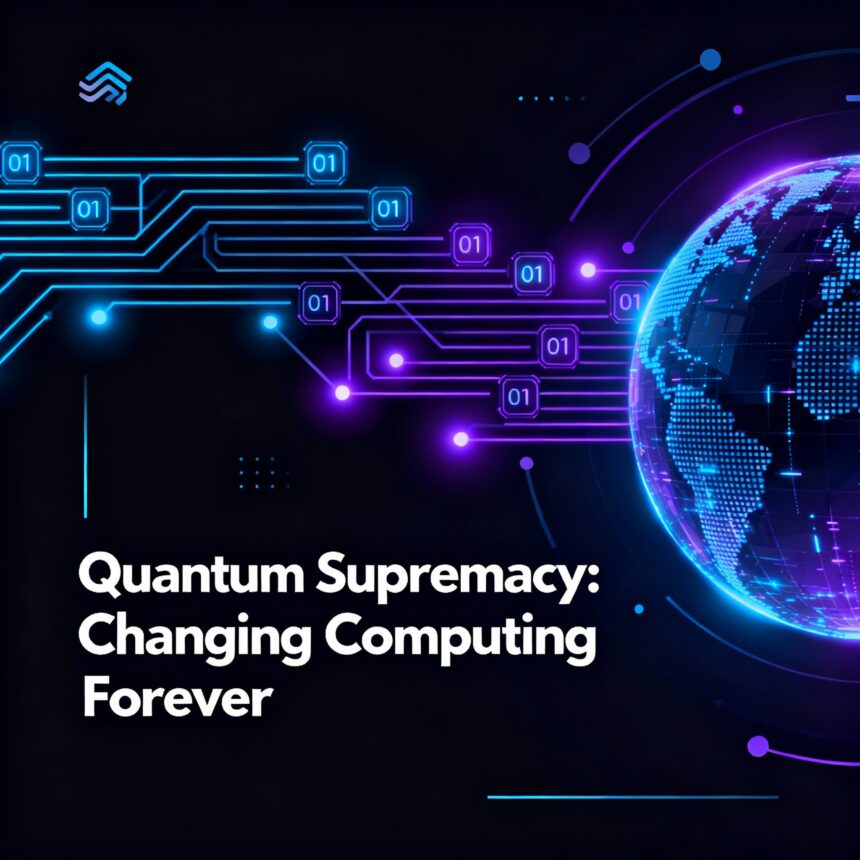
The Dawn of Unprecedented Computing Power
Quantum supremacy represents a pivotal milestone where quantum computers can solve specific problems that classical computers cannot tackle within any reasonable timeframe. This breakthrough has moved from theoretical possibility to demonstrated reality, marking the beginning of a computing revolution that promises to transform entire industries and reshape our technological landscape.
The term, coined by physicist John Preskill in 2011, has evolved beyond its original definition as researchers achieve increasingly impressive demonstrations of quantum advantage. Recent breakthroughs have shown quantum computers solving complex problems in minutes that would take classical supercomputers thousands or even millions of years to complete.
Breakthrough Achievements Reshaping the Field
Google’s Quantum Milestones
Google has achieved multiple quantum supremacy demonstrations, most notably with their Sycamore processor in 2019, which completed a random quantum circuit sampling task in 200 seconds that would have taken the world’s most powerful classical supercomputer 10,000 years. More recently, Google’s Willow chip has demonstrated error correction capabilities that scale exponentially with more qubits, performing benchmark computations in under five minutes that would take classical computers 10 septillion years.
D-Wave’s Real-World Applications
 In a significant development, D-Wave became the first company to demonstrate quantum supremacy on a useful, real-world problem. Their annealing quantum computer successfully performed magnetic materials simulation in minutes that would require nearly one million years and more electricity than the world’s annual consumption using classical supercomputers.
Mathematical Proof of Quantum Advantage
 Researchers at the University of Texas Austin, using 12 qubits from Quantinuum’s quantum computer, achieved the first mathematically proven demonstration of quantum supremacy that cannot be overcome by improvements in classical algorithms. This breakthrough addresses previous criticisms where classical computers eventually caught up to quantum demonstrations.
Revolutionary Applications Across Industries
Cryptography and Security Transformation
 Quantum computing poses both threats and opportunities for cybersecurity. Google’s recent research indicates that quantum computers with one million qubits could break RSA-2048 encryption in under a week, a dramatic reduction from previous estimates of 20 million qubits. This represents a 20-fold decrease from earlier projections, highlighting the rapid advancement of quantum algorithms and error correction techniques.
Shor’s algorithm, developed in 1994, demonstrated that sufficiently powerful quantum computers can efficiently factor large numbers, threatening the foundation of modern cryptography. However, this same capability is driving the development of quantum-resistant cryptography and quantum key distribution systems that offer theoretically unbreakable security.
Drug Discovery and Healthcare Revolution
Quantum computing is revolutionizing pharmaceutical research by enabling precise molecular simulations that are impossible for classical computers. Quantum systems can model protein folding, predict molecular interactions, and simulate complex biochemical processes with unprecedented accuracy. This capability could reduce drug development timelines from decades to years while enabling the discovery of treatments for previously intractable diseases.
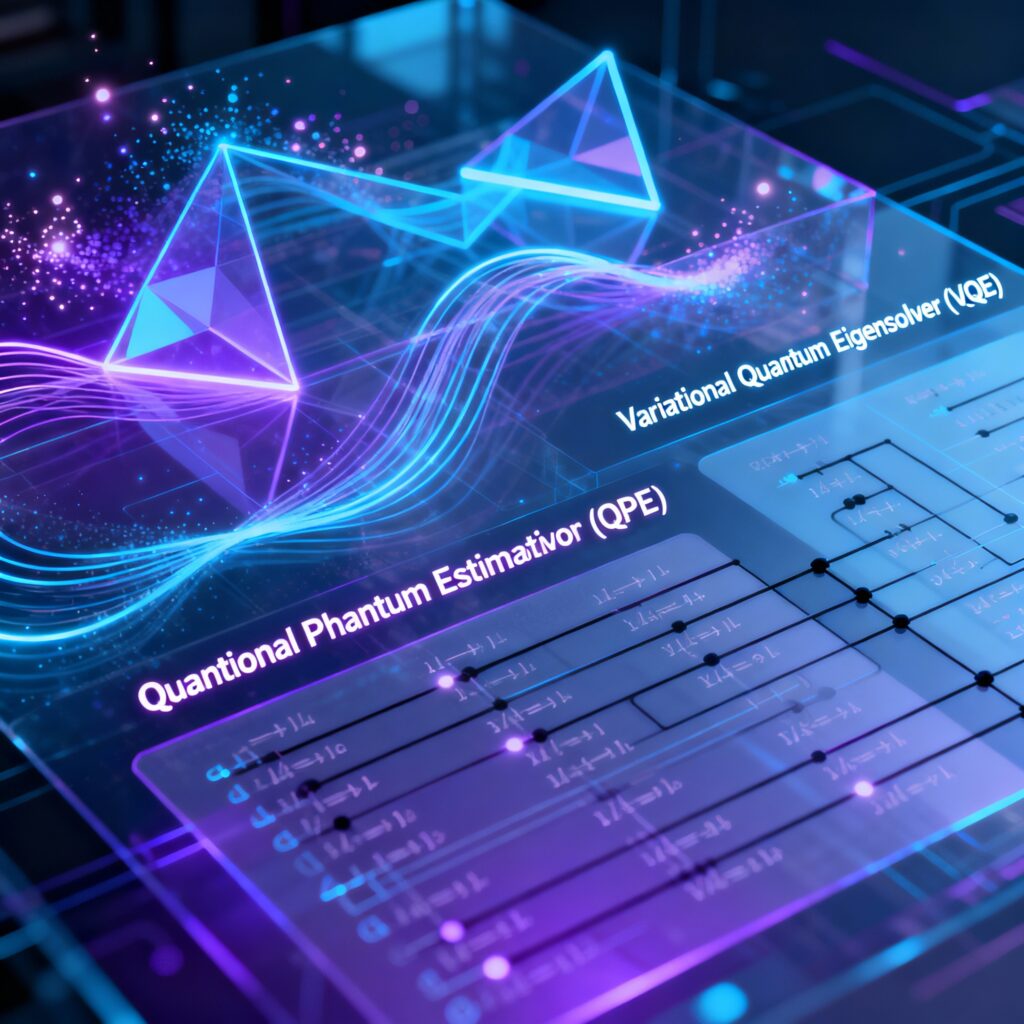
Variational Quantum Eigensolver (VQE) and Quantum Phase Estimation (QPE) algorithms are being used to solve the Schrödinger equation for complex molecules, providing insights into electronic structures and enabling more accurate predictions of drug behavior in the human body.
Artificial Intelligence and Machine Learning Enhancement
Quantum machine learning (QML) represents a convergence that could dramatically accelerate AI development. Quantum computers can process vast datasets exponentially faster than classical systems, enabling more accurate and timely predictions in fields ranging from finance to healthcare.
Quantum-enhanced algorithms can improve pattern recognition, optimization problems, and neural network training while overcoming the limitations of classical computing in handling large-scale AI models. Companies like Quantinuum are actively rebuilding machine learning techniques for natural language processing using quantum principles.
Industry-Wide Economic Impact
Massive Economic Potential
Economic projections for quantum computing’s impact are staggering. The McKinsey Global Institute estimates quantum computing could unlock $3.5 trillion to $5.3 trillion in annual global economic value by 2035. More conservative estimates suggest $2.3 trillion in direct economic impact by 2035, with indirect effects potentially doubling this figure.
The quantum computing market itself is experiencing explosive growth, from an estimated $3.52 billion in 2025 to a projected $20.20 billion by 2030, representing a compound annual growth rate of 41.8%. This growth is driven by hardware advances, increased cloud accessibility, and rising investments from both private and public sectors.
Industrial Transformation Timeline
Near-term applications (2025-2028) include quantum-enhanced optimization for logistics and finance, limited drug discovery applications, and specialized quantum sensors worth an estimated $2.3 billion market by 2030.
Medium-term developments (2028-2030) will see industry-specific quantum solutions deployed in finance, healthcare, and logistics, along with the introduction of commercial quantum-enhanced products and services.
Long-term revolution (2030+) promises general-purpose fault-tolerant quantum computers capable of solving a wide range of problems, potentially establishing a quantum internet for secure global communications.
Technical Challenges and Limitations
Hardware and Error Correction Obstacles
Despite remarkable progress, quantum computing faces significant technical hurdles. Decoherence remains a primary challenge, with qubits losing their quantum state within microseconds to milliseconds due to environmental interference. IBM’s superconducting qubits, for example, maintain coherence for only 100-200 microseconds, severely limiting computational complexity.
Error rates for quantum operations typically range from 0.1% to 1% per gate, requiring extensive error correction that demands thousands of physical qubits to create a single stable logical qubit. Current quantum computers with 100-1,000 qubits fall far short of the millions needed for fault-tolerant quantum computing.
Scalability and Connectivity Issues
Adding more qubits increases noise and crosstalk between quantum components, degrading overall system performance. IBM’s 433-qubit Osprey processor, despite its impressive scale, still struggles with error rates that limit practical applications. The challenge lies not just in building more qubits, but in maintaining uniform performance and connectivity across all components.
Environmental Requirements
Quantum computers require extreme operating conditions, including ultra-low temperatures near absolute zero and complete isolation from vibrations and electromagnetic interference. These requirements make quantum systems expensive to build and maintain while limiting their accessibility.
Societal and Geopolitical Implications
The Quantum Divide
The emergence of quantum supremacy is creating a new form of technological inequality—the “quantum divide”. As of 2021, only 17 countries have developed national quantum strategies, while more than 150 countries lack any quantum research programs. This disparity threatens to create unprecedented gaps in economic and technological development.
Nations and corporations with quantum capabilities could dominate entire industries, from pharmaceuticals to finance. If quantum advantages become concentrated among a few entities, it could lead to monopolistic control over crucial sectors and exacerbate global inequalities.
National Security and Global Competition
The quantum race has become a geopolitical battleground, with the United States, China, and other major powers investing heavily in quantum research and development. The World Economic Forum identifies geopolitical risks related to quantum technology as major threats to global business continuity, potentially reducing global GDP by up to 5% by 2030.
Quantum computing’s impact on cryptography raises significant national security concerns, as enhanced computational power could break many current cryptographic systems protecting global digital communications. This has accelerated efforts to develop quantum-resistant security measures and establish international quantum governance frameworks.
The Path Forward: Challenges and Opportunities
Investment and Development Trends
Global investment in quantum computing exceeded $1.3 billion in 2024, with projections reaching $6 billion by 2030. Major cloud providers are integrating quantum computing services, making the technology accessible to broader audiences and accelerating practical applications.
IBM CEO Arvind Krishna predicts significant advances in error correction and coherence times by the end of the decade, with goals to extend qubit coherence to a full millisecond. This improvement could enable quantum computers to perform calculations impossible for classical machines.
Addressing the Talent Gap
McKinsey identifies the talent shortage as the biggest bottleneck in quantum computing adoption. Educational systems must evolve to prepare workers for quantum-transformed industries while ensuring broader access to quantum literacy and training programs.
Responsible Development Frameworks
The quantum revolution requires careful consideration of ethical implications, including surveillance capabilities, privacy protection, and equitable access to quantum benefits. Developing robust regulatory frameworks and international cooperation mechanisms will be crucial for ensuring quantum technologies benefit society broadly rather than concentrating power among a few entities.
Transforming the Future of Computing
Quantum supremacy represents more than a technological milestone—it signals the beginning of a computational revolution that will fundamentally alter how we approach complex problems across every sector of society. From breaking current encryption standards while enabling unbreakable quantum security, to accelerating drug discovery and enhancing artificial intelligence, quantum computing promises to solve challenges that have long seemed insurmountable.
The journey ahead involves overcoming significant technical challenges, addressing societal implications, and ensuring equitable access to quantum benefits. As companies like IBM and Google work toward fault-tolerant quantum computers by 2029-2030, the quantum future is rapidly approaching, promising to transform not just computing, but the very fabric of technological civilization.
The question is no longer whether quantum supremacy will change computing forever—it’s how quickly we can harness its potential while responsibly managing its transformative power. The quantum revolution has begun, and its impact will reshape every aspect of our technological world.