
Quantum computing represents one of the most exciting frontiers in technology today, promising to solve problems that would take classical computers centuries to complete. Unlike the traditional computers we use daily, quantum computers harness the strange and powerful properties of quantum mechanics to process information in fundamentally new ways.
What Makes Quantum Computers Different?
The key difference between classical and quantum computers lies in how they store and process information. Classical computers use bits as their basic unit of information, which can only be in one of two states: 0 or 1, representing “off” or “on”. Quantum computers, however, use quantum bits or qubits, which can exist in multiple states simultaneously.
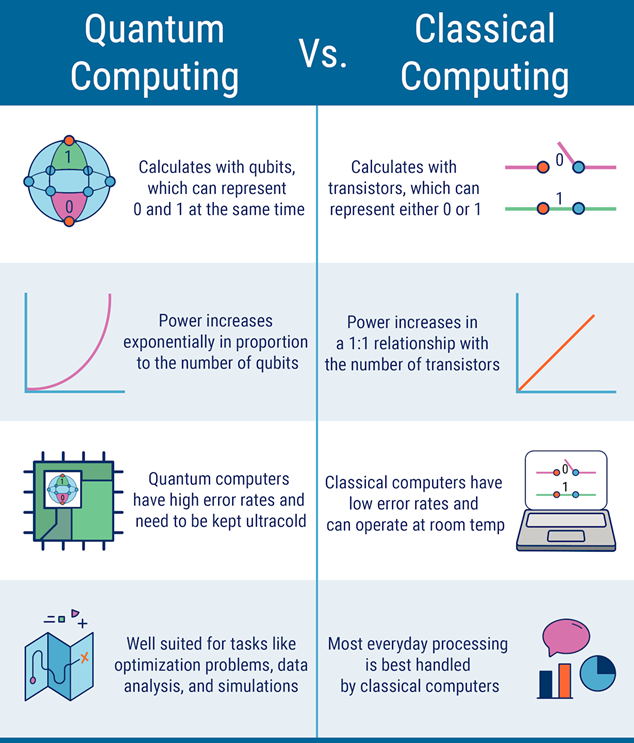
Think of a classical bit like a light switch that’s either completely off or completely on. A qubit, on the other hand, is like a spinning coin—while it’s spinning, it’s neither fully heads nor tails, but a combination of both possibilities at once. This unique property is what gives quantum computers their incredible potential power.
The Core Principles of Quantum Computing
Superposition: The Power of Multiple States
Superposition is perhaps the most important concept in quantum computing. It allows qubits to exist in a combination of 0 and 1 states simultaneously. While a classical computer with 10 bits can only represent one of 1,024 possible combinations at a time, a quantum computer with 10 qubits can represent all 1,024 combinations simultaneously.
Comparison of classical bits with distinct states and quantum qubits illustrating superposition.
This exponential scaling is what makes quantum computers so powerful. As you add more qubits, the computational power doesn’t just increase linearly—it grows exponentially. A classical computer with N bits can perform at most N calculations simultaneously, while a quantum computer with N qubits can theoretically perform up to 2^N calculations.
Entanglement: Quantum Connections
Quantum entanglement is another crucial principle that Einstein famously called “spooky action at a distance”. When qubits become entangled, they form a special connection where the state of one qubit instantly affects the state of another, regardless of the distance between them.

Imagine two entangled qubits where one always spins up when measured and the other always spins down. If you change the spin of the first qubit, the second will instantly change to maintain their relationship. This interconnectedness allows quantum computers to process complex relationships between data in ways that classical computers simply cannot.
Decoherence: The Challenge of Maintaining Quantum States
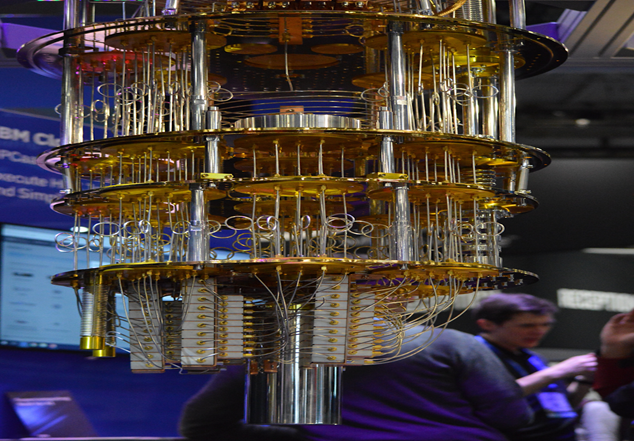
One major challenge in quantum computing is decoherence—the loss of quantum properties due to environmental interference. Qubits are extremely fragile and can lose their quantum state when disturbed by heat, vibrations, electromagnetic fields, or even stray particles.
This is why quantum computers require extreme operating conditions. Most quantum computers operate at temperatures colder than outer space—just a hundredth of a degree above absolute zero—using sophisticated cooling systems with liquid helium.
How Quantum Computers Work
Quantum computers use quantum gates to manipulate qubits, similar to how classical computers use logic gates to process bits. These quantum gates can create superposition, perform rotations on qubit states, and entangle multiple qubits together.
The quantum computing process follows these steps:
- Initialize qubits in a superposition state
- Apply quantum gates to manipulate the qubits
- Allow qubits to interact and become entangled
- Measure the final states to get classical output (0s and 1s)
When qubits are measured, they collapse from their superposition state into definite classical states, providing the final computation result.
Real-World Applications
Quantum computing isn’t just theoretical—it has practical applications that could revolutionize various industries:
Drug Discovery and Healthcare: Quantum computers can simulate molecular interactions with unprecedented accuracy, potentially accelerating the development of new medicines and treatments.
Financial Modeling: Complex optimization problems in finance, such as portfolio management and risk analysis, could be solved much more efficiently.
Cryptography and Security: Quantum computers could break current encryption methods but also enable ultra-secure quantum communication.
Materials Science: Simulating new materials at the quantum level could lead to breakthroughs in batteries, superconductors, and sustainable technologies.
Climate and Environmental Modeling: Better simulations could improve our understanding of climate change and help develop solutions.
Current Limitations and Timeline
Despite their promise, quantum computers face significant challenges:
- High error rates due to environmental sensitivity
- Short coherence times limiting computation duration
- Scalability issues in building systems with thousands of qubits
- Extreme operating requirements including ultra-low temperatures
Current quantum computers are still in the NISQ (Noisy Intermediate-Scale Quantum) era, suitable mainly for research and specialized tasks. Most experts predict that practical, fault-tolerant quantum computers capable of solving real-world problems at scale are still 5-15 years away, with some estimates extending to 2030-2040.
The Future of Computing
Quantum computers won’t replace classical computers but will work alongside them as specialized tools for specific problems. While your laptop will continue handling everyday tasks, quantum computers will tackle challenges in optimization, simulation, and cryptography that are beyond the reach of classical systems.
Understanding quantum computing basics helps us appreciate both the incredible potential and the significant challenges that lie ahead in this revolutionary field. As researchers continue to overcome technical hurdles and build more stable quantum systems, we’re moving closer to a future where quantum advantage becomes a practical reality across multiple industries.